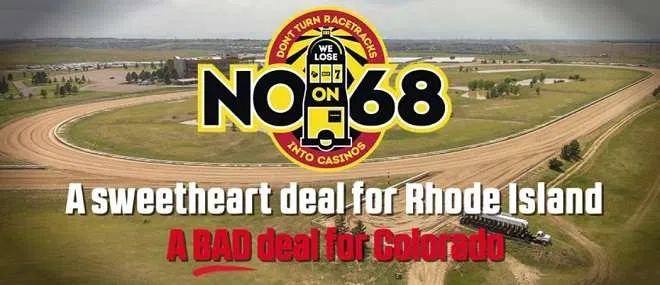
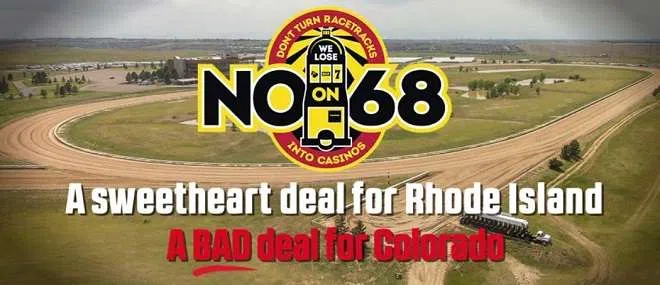
A screenshot from a “No on 68” commercial airing in Colorado.
By Kim Kalunian, WPRO News
Folks in Colorado are getting an earful about Rhode Island this election season, and a local casino is spending millions out there to combat the message.
A campaign called “No on 68” is running ads calling an amendment going before Colorado voters this fall a “sweetheart deal for Rhode Island.” They claim the only one who’ll benefit from its passage is a “Rhode Island casino.”
That casino happens to be Twin River, whose parent company, Twin River Worldwide Holdings, also owns a Colorado racetrack – and they’ve been pouring millions into a campaign to counteract the anti-Amendment 68 message.
If voters pass Amendment 68, horse racetracks in Arapahoe, Mesa and Pueblo counties would be able to have table games and slot machines. Right now, the only racetrack currently in those counties is Arapahoe Park, owned by Mile High USA, a subsidiary of Lincoln-based Twin River.
Under the proposal, thirty-four percent of revenue from slots and table games from Arapahoe Park (and any others that open) would go towards public education, but not everyone thinks it’s a good deal for Coloradans.
“A Bad Deal for Colorado”
Michele Ames is the spokeswoman for a group called “No on 68” that’s been running TV ads in Colorado with the tagline: “Amendment 68: A sweetheart deal for Rhode Island, a bad deal for Colorado.”
Ames says the way the amendment creates a monopoly for Arapahoe Park, and its parent company, Rhode Island-based Twin River.
“They get everything they want with no competition and [they are] written, locked into our state constitution,” said Ames in a telephone interview from Colorado Monday. “We get, I guess, a very large casino that doesn’t pay for itself in terms of impact fees, no local vote for the folks who would have the casino in their own back yard and not nearly enough for K-12 education to solve the genuine challenges that we have in K-12 funding.”
Ames says the K-12 funding portion of the amendment is just a “thinly veiled attempt to get it passed.”
A high stakes bet
The campaign to get the amendment passed is becoming an expensive one. Earlier this month the Washington Post reported:
“ …[C]ompeting casino interests are making it one of the most expensive contests of the year, not just in Colorado but in the entire country.
Coloradans for Better Schools, the committee that favors expanded gaming, has raised more than $12 million to persuade voters. The group is funded almost entirely by Mile High USA, the Rhode Island-based owners of the Arapahoe Park Racetrack, southwest of Denver, another site that would be allowed to expand gaming.”
According to Colorado campaign finance reports, a group called “Coloradans for Better Schools” – funded almost entirely by Mile High USA (the subsidiary of Twin River) – has now raised $16.8 million, and spent most of it, to persuade voters to vote “yes” on the amendment.
This comes after the Rhode Island General Assembly’s approval of a budget in June that includes $1.8 million from the state towards $17 million in approved Twin River marketing expenses this fiscal year. The casino had originally asked for closer to $4 million.
“They don’t have any money to market in Rhode Island but they have $12 million to dump into a campaign here in Colorado,” Ames said.
Patti Doyle, the spokeswoman for Twin River, called Ames’ accusation “inaccurate.”
“Twin River does actively market in the RI and MA markets,” said Doyle in an email. “The investment the State of Rhode Island makes in partnering with Twin River on some approved marketing expenses is due to the benefit the State reaps from a vibrant, successful Twin River. Since the State receives 62 percent of the revenue from [slot machines] alone, they are our active partner and only stand to benefit from increased activity at Twin River, which advertising can and does produce.”
And the Rhode Island Lottery says there’s no way Twin River could spend Rhode Island’s money in Colorado. According to RILOT, they must approve Twin River’s expenses, which are submitted on a monthly basis. Those approved expenditures could only include direct marketing of Twin River’s table games and slots, not anything related to Colorado’s Arapahoe Park.
On the other side of the argument, the “No on 68” group is giving proponents a run for their money and has raised close to the same amount. According to campaign finance reports, the “Don’t Turn Racetracks into Casinos” group is funded almost entirely by other, Colorado-based casinos.
But Ames insists it’s not the competition her group is worried about.
“What we’re opposed to is them creating this monopoly in the Denver metropolitan area,” she said. “It’s not [about] competition.”
She also says the group is upset with the lack of local vote – residents of Arapahoe and Pueblo would not get the opportunity to also pass the amendment, as voters in Lincoln did with expanded gaming there in 2012.
“They don’t want to extend the same courtesy to the folks here in Colorado,” said Ames of Twin River.
Still, the proponents of the amendment say it’s a good move for public education in the state
“Amendment 68 will increase K-12 public and charter school funding by more than $114 million each year by permitting expanded limited gaming at Arapahoe Park horse racetrack where racing and wagering have existed for decades,” Monica McCafferty, spokeswoman for “Yes on 68” wrote in an email statement. “That figure will only increase each year, particularly if live horse racing and limited gaming expands to Mesa and Pueblo counties, which the amendment also allows.”
“A sweetheart deal for Rhode Island”
In July, before the amendment was even on the November ballot, Providence Journal reporter Paul Grimaldi interviewed Twin River Chairman John Taylor about his efforts in Colorado. He wrote:
“The proposed Colorado ballot initiative and the Mississippi casino purchase are both part of Twin River’s efforts to survive the coming onslaught of competition from Massachusetts, where efforts are underway to expand gambling. ‘Growing the business . . . solidifies our position in Rhode Island at an important time,’ Taylor said by phone from a Colorado airport”
Twin River Chairman John Taylor was not available for an interview with WPRO on the subject, but spokeswoman Patti Doyle says the expanded gaming in Colorado is part of Twin River’s three-prong strategy to “maintain its competitiveness in this challenging gaming environment.”
“First is to ensure a positive guest experience at Twin River so that when MA casinos come on line in the near future, we can retain our customer base in the face of new competition,” she wrote. “Second, Twin River seeks to apply lessons learned and successes achieved here in other markets, and explore acquisitions in other geographic regions such as Biloxi, MS. Third, the company is exploring the possibility of expanding its offerings at an existing venue in CO.”
Doyle says amendment 68 is similar to the ballot referendum that allowed table gaming at Twin River.
“Now, residents of Colorado have the opportunity to engage in in a similar dialogue,” she said, “And the beauty of the process is they can decide for themselves what the future of Arapahoe Park should be.”
A Colorado-based poll on the question showed 44-percent of voters opposed it, 33-percent supported it and 19 percent were undecided.
|
An award-winning journalist and theater critic – and a performer at heart. Kim covers everything from politics and breaking news to food and theater. Kim is the weekday afternoon news anchor on WPRO.
|
 Kim Kalunian