By Kim Kalunian, WPRO News
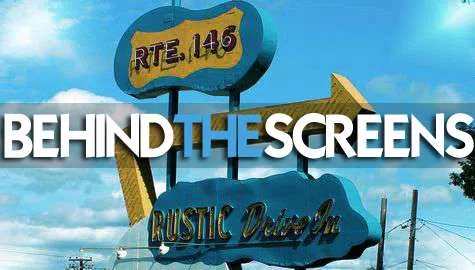
The Rustic Drive in has stood the test of time, but this week, it’s taking a giant leap into the 21st century by going digital.
The North Smithfield attraction dates back to 1951, and is still a popular destination for Rhode Islanders and tourists alike. During its first few weekends of the 2013 season, general manager Nicole Pattie said the drive-in nearly sold out.
The fascinating thing about the Rustic is that for almost as long as they’ve been around, they’ve been using the same equipment to show their films. The projectors inside the small booth in the heart of the enormous parking lot date back to the 1950’s, while the lamp houses – the cases that protect the powerful light bulbs – are from the 1970’s.
But all of that changed last weekend.
On Sunday, all of the equipment that’s been used at the Rustic since its inception was removed to make way for digital projectors.
Starting this week, there will be no need to keep a trained projectionist on staff. The staff will no longer receive shipments of reels of 35 millimeter film that need to be cut, taped and fed through machines. No longer will the film make that signature “click, click, click” as it makes its way through the projectors.
Instead, three digital projectors will be used starting Thursday night. Pattie said customers should expect to see a better, sharper image.
“It will be a crisper, brighter picture,” she said. “It’s amazing the difference.”
The operational cost of the digital projectors will be roughly the same as the standard film projectors they’ve used for more than 60 years. Pattie said it’s a give and take: the new equipment is temperamental and uses a lot of energy, but they won’t need the specialized staff to operate it.
Pattie, a trained projectionist herself, said it’s a dying art.
On a balmy Saturday afternoon she stood inside the epicenter of the Rustic, the projection room, and held up a film reel. Each film arrives on multiple reels. The number of reels depends on the length of the film. The latest animated flick, “Epic,” for example, came in five pieces. It runs about 102 minutes.
The separate reels get literally taped together, something Pattie does effortlessly with the aid of a special measuring and cutting tool. Using what looks like yellow-edged scotch tape, she attaches the ends together “tail to head.” And that’s how a movie is made.
Pattie said she’s seen some disasters in her time (“Static electricity is not your friend,” she warns) but otherwise the films run smoothly through their projectors.
Placed onto a palette, something that resembles a giant, metal turntable, the film is fed through a series of smaller spools by “the brain.” The brain lies at the center of the turntable, and depending on the length of the movie, it tells the table how quickly to turn and feed the projector. It’s centuries-old technology, but it still works just fine.
So why is the Rustic getting rid of it?
“The movie companies have decided this is the last year they’re making [35 millimeter] film,” said Pattie. “If you don’t convert, you basically go under.”
Pattie said the movie companies are going to make film “very hard to get after this year.”
“That’s why you’ve seen a lot of theaters close,” she said.
But not the Rustic. On Sunday, they welcomed three digital projectors into their projection booth. Instead of 35 millimeter films, the projectors will “ingest” (industry lingo for “download”) the movies. Pattie said they’ll be mailed hard drives, or get satellite transmissions of new releases.
“It’s basically a giant computer,” said Pattie of the new technology.
Though the Rustic has been open for a few preview weekends now, they’ll open full time starting Thursday, the same night they’ll debut their digital projection systems.
Even with the modern upgrades, the Rustic will still be a retro attraction. It’s the only drive-in in the state, and Pattie said it has drawn customers from places as far away as Ohio.
The lot can fit more than 500 cars on a good day, and Pattie is hoping to break her record of 506 (set during “The Dark Knight Rises”) by cramming in 520.
“That’s my goal, I want to see how many we actually fit in here,” she said.
The drive-in’s popularity is so good that they’ve even launched a Rustic Rewards program; visit nine times and get the tenth viewing free.
Despite the digital upgrades, ticket prices will remain the same at $25 per carload.
“It’s good for families,” said Pattie. “If you don’t want to go to the traditional theater and disturb everyone else…if your kid cries, you roll up your windows.”
Patrons can hear the sound from the movie they’re watching by tuning their car radios to a specific station.
When the sun is down, the summer breeze is blowing and the lot is full, the Rustic becomes a glowing piece of cinematic magic.
White-painted plywood becomes a movie screen. A pockmarked parking lot becomes an auditorium. The year 2013 melts into 1951.
But while the movies are playing, people like Pattie are working to ensure everything runs smoothly. The new equipment must be kept cool, and air conditioners have been installed inside the projection booth to keep everything status quo.
Careful steps are taken to protect the equipment. The bulbs inside the lamp houses are extremely expensive and fragile – just a bump and they’ll explode into tiny shards, explained Pattie.
“These are 4,500 watt bulbs,” said Pattie, pointing inside the lamp house at an elongated glass tube. Indoor theaters use 2,000 watt bulbs, but the Rustic doubles that wattage to deal with any natural light from the moon.
Behind the screens, the Rustic is changing to meet the demands of patrons and Hollywood. But when the popcorn is popped and the audience is ready for their double feature Thursday, the iconic Rhode Island spot won’t really be any different than it was 60 years ago. And Pattie hopes it will stay that way for 60 more years to come.
“We plan to stay here as long as we can,” she said.
For more information on the Rustic Drive-In, click here.
|
|
 Kim Kalunian